Monday, February 21, 2011

Get People to Opt-In to Social Media
Although you are a firm believer in social media and all that it offers, you are still bound to come across business associates who don’t seem to understand its value and how amazing it can be for their business.
The nonbeliever
Social media nonbelievers are generally intelligent and well-educated people. They are well rounded and interesting. The only thing that is missing when it comes to online activities is their desire and their need for social media (or so they believe). Nonbelievers come from the school of thought that aspires to see no value in all things technologic.
However, if you can see your way clear to opening up a discussion with a nonbeliever about social media, in other words, if you can pique their interest enough for them to want to know what it is all about, you have a chance at converting them from nonbelievers to believers. Nonbelievers initially believe that it is not possible to have discussions online that will lead to any real business. Everyone who understands anything about social media knows that interactions through are based on interactions among people. Although it isn’t always obvious how discussions turn into revenue, it is easy to explain how this happens. Conversations lead to a relationship that is built on trust and credibility and trust and credibility eventually leads to people wanting to buy what you are selling because you have a relationship that has become important to them.
The stereotype of social media
It is entirely possible that people who have no involvement in social media have been paying enough attention to remember some of the names of the various online channels. Remember that their familiarity with some of the more popular names, such as Facebook, Twitter and LinkedIn, doesn’t mean that they have an understanding of the capabilities of those channels. As you know, social media has gotten some seriously bad press over time and there are still many people who actually believe that the more popular social networks are only interesting and appropriate for teenagers. Of course, that couldn’t be any further from the truth. In your mission to convert a nonbeliever, one of your principle obligations is to educate him/her about the tremendous usefulness that social media has for business.
Your online business marketing strategy
Once you have had the conversation about social media only being useful for teenagers, you next line of defense is producing solid evidence that proves that you can actually successfully do business online and truly increase your business’s revenue. Please don’t be surprised if the reaction that you get is still rather skeptical. Once you have produced positive proof that social media seriously contributes to the bottom line of your business, it should hopefully get that person to start thinking that maybe there is something to it. Even if the conversion seems rather slow at first, you should try to be patient. Your goal was not to snap your fingers and poof, the nonbeliever was converted instantly (although that would be delightful). Rather, your goal was to create a small crack in his or her solid wall of nonbelief and skepticism. Once you have created that small crack, you can inundate the person with more and more useful information on social media. The more information you supply, the wider the crack will become until eventually, the wall will completely crumble and the nonbeliever will become one of social media’s most loyal and passionate fans.
Putting social media in terms that the nonbeliever can understand
If you speak in terms of advantages that he/she can appreciate and apply to his/her own business, you have a good chance of truly making him/her see what you see. For example, a good angle to discuss is how the Internet allows you to keep a close watch on your business activities, how the information that you gather online allows you to categorize your online connections very effectively, and how the Internet allows you to gather solid metrics that will enable you to hone your activities so that you can serve your target market most appropriately and successfully.
Conclusion
Fortunately, the majority of people whom you come across in business understand and believe in the power of social media and its vast and extremely positive implications for your business. On the rare occasion when you come across (or perhaps have known for a long time) the nonbeliever, you should consider it a welcome challenge to educate that person and really enlighten him or her about all that social media has to offer their business.
The nonbeliever
Social media nonbelievers are generally intelligent and well-educated people. They are well rounded and interesting. The only thing that is missing when it comes to online activities is their desire and their need for social media (or so they believe). Nonbelievers come from the school of thought that aspires to see no value in all things technologic.
However, if you can see your way clear to opening up a discussion with a nonbeliever about social media, in other words, if you can pique their interest enough for them to want to know what it is all about, you have a chance at converting them from nonbelievers to believers. Nonbelievers initially believe that it is not possible to have discussions online that will lead to any real business. Everyone who understands anything about social media knows that interactions through are based on interactions among people. Although it isn’t always obvious how discussions turn into revenue, it is easy to explain how this happens. Conversations lead to a relationship that is built on trust and credibility and trust and credibility eventually leads to people wanting to buy what you are selling because you have a relationship that has become important to them.
The stereotype of social media
It is entirely possible that people who have no involvement in social media have been paying enough attention to remember some of the names of the various online channels. Remember that their familiarity with some of the more popular names, such as Facebook, Twitter and LinkedIn, doesn’t mean that they have an understanding of the capabilities of those channels. As you know, social media has gotten some seriously bad press over time and there are still many people who actually believe that the more popular social networks are only interesting and appropriate for teenagers. Of course, that couldn’t be any further from the truth. In your mission to convert a nonbeliever, one of your principle obligations is to educate him/her about the tremendous usefulness that social media has for business.
Your online business marketing strategy
Once you have had the conversation about social media only being useful for teenagers, you next line of defense is producing solid evidence that proves that you can actually successfully do business online and truly increase your business’s revenue. Please don’t be surprised if the reaction that you get is still rather skeptical. Once you have produced positive proof that social media seriously contributes to the bottom line of your business, it should hopefully get that person to start thinking that maybe there is something to it. Even if the conversion seems rather slow at first, you should try to be patient. Your goal was not to snap your fingers and poof, the nonbeliever was converted instantly (although that would be delightful). Rather, your goal was to create a small crack in his or her solid wall of nonbelief and skepticism. Once you have created that small crack, you can inundate the person with more and more useful information on social media. The more information you supply, the wider the crack will become until eventually, the wall will completely crumble and the nonbeliever will become one of social media’s most loyal and passionate fans.
Putting social media in terms that the nonbeliever can understand
If you speak in terms of advantages that he/she can appreciate and apply to his/her own business, you have a good chance of truly making him/her see what you see. For example, a good angle to discuss is how the Internet allows you to keep a close watch on your business activities, how the information that you gather online allows you to categorize your online connections very effectively, and how the Internet allows you to gather solid metrics that will enable you to hone your activities so that you can serve your target market most appropriately and successfully.
Conclusion
Fortunately, the majority of people whom you come across in business understand and believe in the power of social media and its vast and extremely positive implications for your business. On the rare occasion when you come across (or perhaps have known for a long time) the nonbeliever, you should consider it a welcome challenge to educate that person and really enlighten him or her about all that social media has to offer their business.
Sunday, February 20, 2011
5 Social Media Tips for Ecommerce Marketing
If you run an ecommerce business, chances are your customers – regardless of their age, gender or economic status – are active on social networks and social media sharing sites.
Just consider the statistics from social media monitoring site Pingdom:
Leverage these five social media marketing tips for ecommerce to either get started with more social digital marketing or take your current social strategy to the next level:
Find out where your customers are congregating by:
For example, promote a contest via social media. Last fall, TopRank® Online Marketing leveraged this tactic for one of its ecommerce clients. TopRank used the client’s blog and Facebook fan page to promote a Halloween contest to name the best costume. This initiative not only drove additional traffic to the client’s website, but also helped increase the number of Facebook fans.
Alternately, offer an exclusive item to social media followers or fans, such as free shipping or a weekly coupon. You can also offer “breaking news” that does not appear anywhere else, like pre-product release announcements or an inside look at your company’s inter-workings.
Incorporate some of these ideas into your ecommerce social media marketing strategy:
 Many ecommerce sites leverage social channels to make it even simpler for customers to purchase their products. 1-800-Flowers has taken this idea to the max (see image above). It was the first ecommerce site to launch a Facebook store, allowing customers to browse and purchase its products directly through Facebook.
1-800-Flowers may be an extreme case, but ecommerce sites large and small can still indirectly sell products through their social profiles. For example, highlight new products or best-sellers and provide a link to the order page on your website. It may not be quite as simple as purchasing directly from the social profile, but it can be just as effective.
The five ideas are just the tip of the iceberg when it comes to ecommerce social media marketing. What social media tactics have you found to be successful?
Just consider the statistics from social media monitoring site Pingdom:
- Males and females almost equally use social sites (47% vs. 53%)
- 61% of Facebook users are middle aged or older, with the average age being 37
- 18- to 24-year-olds don’t dominate any particular social networking site; they’re spread out all over
Leverage these five social media marketing tips for ecommerce to either get started with more social digital marketing or take your current social strategy to the next level:
1. Go Where Your Customers Are
Very few things in life promise endless options – digital and social media marketing being one exception. From Facebook to Twitter to LinkedIn to YouTube, there’s no limit to the number of social networking channels available for your business to leverage. Key to successful social media marketing for ecommerce is choosing the right channels to reach customers.Find out where your customers are congregating by:
- Asking them. Sounds overly simplistic, but sending a formal survey to customers or more informally polling them on your website can provide a wealth of knowledge.
- Monitoring social sites. Use a free tool like Social Mention or Trackur. For something far more robust use tools like Radian6 to discover how and where customers are talking about your brand, your competitors or target keywords.
- Leveraging the stats. Some sites like Facebook are transparent when it comes to user statistics. Or leverage research conducted by third-party firms like eMarketer.
- Revivew backlinks, job postings, news announcements and keyword rankings of competitors on a regular basis to get a glimpse into their online marketing health.
2. Monitor What Your Competitors Are Doing
Whether your ecommerce business is new to social media marketing, or just need to take your efforts up a notch, competitive intelligence can be very useful. Spend some time by conducting a competitive audit of your top five competitors on the social web. Include:- The social sites in which they are active
- The type of content they publish on the social web
- The number of followers/fans/views they have on each site
- How they promote specific products, programs or events via social media
3. Promote Exclusive Offers Through Social Media
In order for your ecommerce business to gain a following on whatever social channel you choose, entice customers with something they can’t get anywhere else.For example, promote a contest via social media. Last fall, TopRank® Online Marketing leveraged this tactic for one of its ecommerce clients. TopRank used the client’s blog and Facebook fan page to promote a Halloween contest to name the best costume. This initiative not only drove additional traffic to the client’s website, but also helped increase the number of Facebook fans.
Alternately, offer an exclusive item to social media followers or fans, such as free shipping or a weekly coupon. You can also offer “breaking news” that does not appear anywhere else, like pre-product release announcements or an inside look at your company’s inter-workings.
4. Don’t Just Push Products and Promotions
The primary goal of your ecommerce site may be to sell products, but your social media marketing strategy should encompass a wider range of tactics that simply promoting offerings. With too much product pushing and not enough engagement, you’re unlikely to experience optimal success.Incorporate some of these ideas into your ecommerce social media marketing strategy:
- Share messages or news stories from external sources
- Create a blog on your website and feed blog content to your social accounts
- Ask questions, participate in discussions or poll your customers via social media
- Post pictures from company events or videos from your CEO’s speaking engagements
5. Sell Products Through Social Networks
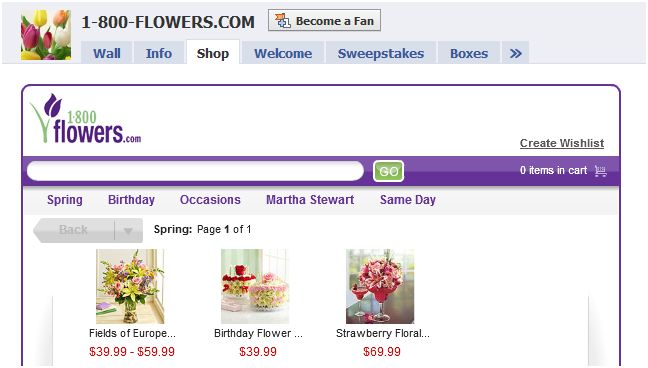
1-800-Flowers maximizes the use of social media for its marketing efforts.
1-800-Flowers may be an extreme case, but ecommerce sites large and small can still indirectly sell products through their social profiles. For example, highlight new products or best-sellers and provide a link to the order page on your website. It may not be quite as simple as purchasing directly from the social profile, but it can be just as effective.
The five ideas are just the tip of the iceberg when it comes to ecommerce social media marketing. What social media tactics have you found to be successful?
Saturday, February 19, 2011
Social Media for Competitive Intelligence
Today, thanks to the ever growing world of social media, it’s a whole lot easier to find information about your competition. Here are a few simple tips to get started:
1. Be a Twitter Spy. Set up a Tweetbeep. If you can use Google Alerts you can use Tweetbeep. Just go to Tweetbeep.com and enter your competitors’ names. You’ll be notified when anyone Tweets about your competition. The information you receive will be a gold mine. Your competitors’ clients will tweet about how well (or poorly) the latest pitch went, their employees will complain about working all night to get the new product into beta. A reporter will talk about using them for a source. Customers will talk about pricing. The HR intern will tell you that layoffs are coming today.
Did you hear that something big is happening at a competitor and you can’t wait to be Tweetbeeped? Then just go to http://search.twitter.com and type in search strings like “[Competitor name layoff” “[Competitor name] acquired” “[Competitor name] president” People will share scoops on Twitter that they never would in person or on the phone.
You can also start following your competitors’ executives, managers, employees, interns and contractors. Not to mention, their biggest clients. When news is coming from the company, you’ll get it from every perspective—giving you the full picture. Of course, don’t be surprised when you get the spin from the company president and PR director and the juicy stuff from the interns and contractors.
2. Get LinkedIn. I’m willing to bet you already have a LinkedIn profile and some good connections on the site. But now, it’s time to start mining LinkedIn for information on your competition. First take a moment to consider what LinkedIn knows about a company: it knows who just joined a company, it knows who left, it knows who received a promotion and it knows who is connected to whom at other companies. Now, rather than rely on a person to write a company profile, aka Wikipedia, LinkedIn can create an automated feed to pull all this together into a shockingly accurate profile. Go ahead and check out your own company profile by searching here: http://www.linkedin.com/companies.
A quick scan will tell you how many people work at the company and who recently left the company. Seeing who left is not only a great tool if you’re looking to recruit from the competition, it’s also a good way to see if a particular department is in the midst of a shakeup.
You can also identify the companies most connected to your competition. This may help you identify where they recruit their employees, who their biggest clients are, and what strategic alliances are most important.
Company divisions and acquisitions are also listed, allowing you to understand the corporate hierarchy. The information on number of employees, revenue (listed even for many private companies), median age, employee gender and the various schools their employees attended, rounds out the picture.
3. Dive deep with Manta. Manta.com is one of the largest and most popular business information sites on the Internet. Manta has profiles on 63 million plus companies, including yours. The site specializes in hard-to-find information about small businesses and other privately held companies. Membership to the site is free and you can use the free contact management system on the site to track and share competitive information with the rest of your staff. The information on companies varies, but in general, you can find annual revenue, key contacts and number of employees. Premium financial reports are also available for a fee. Can’t find the information you need? The site has a question and answer feature that allows users to post a question that can be addressed by the site’s other members.
Interested in seeing who is affiliate with your competitors? Visit their company pages on Manta.com and find Manta members who are associated with the company. You can also see who else (maybe your clients and prospects) who are viewing your competitors pages. And, similar to Tweetbeeps for Twitter, you can an alert on your competitors to be notified when something on their pages changes.
One other point: Your competitors are probably using these same tools to keep tabs on you. Keep an eye on your own social media presence to see the image that you are projecting.
Social media has changed the way we do a lot of things in the business world, including how we keep up on what our competition is up to. Somebody, somewhere out there, is talking about your competitors, opening up a world of information never before available. Now is the time to take advantage of it.
Friday, February 18, 2011
Three Tips for Monitoring Your Competitors on Social Media
Marketers the world over are using social media not only to connect with customers and prospects, but also to see how well their competition is doing. As the wired social world grows in sophistication, so do the means to monitor the conversation.
Sure, it's easier than ever to keep an eye on the competition, but exactly where does one begin, you ask?Here's some help.
Founder Bill Balderaz of Webbed Marketing has offered three sound tips for using social media to keep an eagle eye on your rivals:
Set up Tweetbeep. "If you can use Google Alerts, you can use Tweetbeep," Balderaz notes. Visit Tweetbeep.com to enter competitors' names; you'll get email alerts whenever someone tweets about them: "Competitors' clients will tweet about how well (or poorly) the latest pitch went, their employees will complain about working all night to get the new product into beta. A reporter will talk about using them for a source. Customers will talk about pricing." Twitter spy tool—check!
Get "LinkedIn." Q: What does LinkedIn know about a company? A: Who joined, who left, who got promoted, who's connected to whom. Visit linkedin.com/companies to see your company profile (and your competitors'). Great for recruiting competitive talent, identifying companies intimately connected to your competitors—or checking the veracity of rumors that Rival, Inc. is having a shakeup.
Go deeper with Manta. Manta profiles more than 63 million companies and specializes in hard-to-find information about small businesses and private firms. Use its free membership to track competitive data like annual revenue, key contacts, affiliates and number of employees. Premium financial reports can also be had for a fee.
The Po!nt: Stay in the know. Don't get caught off-guard by rivals that likely use tools to track your movements. Like any good spy, you can know them as well as they know you.
Subscribe to:
Posts (Atom)